
Montgomery County Court Records After a Jail Arrest
The arrest-to-court path in Montgomery County runs through more than one office. A jail booking starts at the local custody level, usually through the Montgomery County Sheriff's Office or another arresting agency. Formal prosecution belongs to the Montgomery County Attorney and the Iowa District Court system. County Attorney Drew B. Swanson is listed as the county's chief legal officer, and Deputy or Assistant County Attorney Bruce E. Swanson is also identified in county records. Their office handles criminal prosecutions, including preliminary hearings, misdemeanors, and felonies.
That separation matters when reading Montgomery County court records after an arrest. A booking entry may describe the reason a person was taken into custody, but the court case tracks what the prosecutor actually filed and what the judge later did with those charges. Use jail inmate records for the custody side and jail mugshots for booking-photo questions. Use the court docket for filed charges, case events, bond orders, amended counts, and outcomes.
The Montgomery County Attorney office is listed at Swanson Law Firm, 209 E Coolbaugh St, Red Oak, IA 51566. The phone number is 712-623-3011, and published office hours are Monday through Friday, 8:00 a.m. to 4:30 p.m. That office is not a jail records desk; it explains why the filed court charges may differ from the arrest labels that appeared at intake.
How to Find Montgomery County Court Records After an Arrest
Iowa Courts Online is the official public docket gateway for Iowa state court cases. The system provides access to the electronic docket maintained by clerk of court offices across Iowa, including Montgomery County. Public case information is free to view, and public docket access does not require registration or a subscription. If the arrest is very recent, the case may not be visible immediately. The Iowa Courts Online help materials state that case data added to the case management system takes one business day to appear; after the case appears, docket data updates in real time.
- Open Iowa Courts Online at iowacourts.state.ia.us/ESAWebApp/DefaultFrame.
- Search by defendant last name and first name, or use a known case ID if one has already been assigned.
- Open the case ID link in the results and confirm that the county, case title, and party names match the arrest being researched.
- Read each listed charge, charge level, event entry, bond order, and disposition separately because one arrest can lead to more than one count.
Some Iowa Courts Online details are not available to every home user. The official help guide says hyperlinks without brackets may be limited to a clerk public-access terminal or a paid subscriber. Subscriber and terminal-only material can include schedule search, advanced trial court searches, some party details, judgment or lien information, exhibit lists, complete financial information, case schedules, bonds, and service return information.
The Iowa Courts Online screen is the most direct public route for filed cases after a Montgomery County arrest.
The Iowa Courts Online public docket gateway is the state case-search system named in the research.
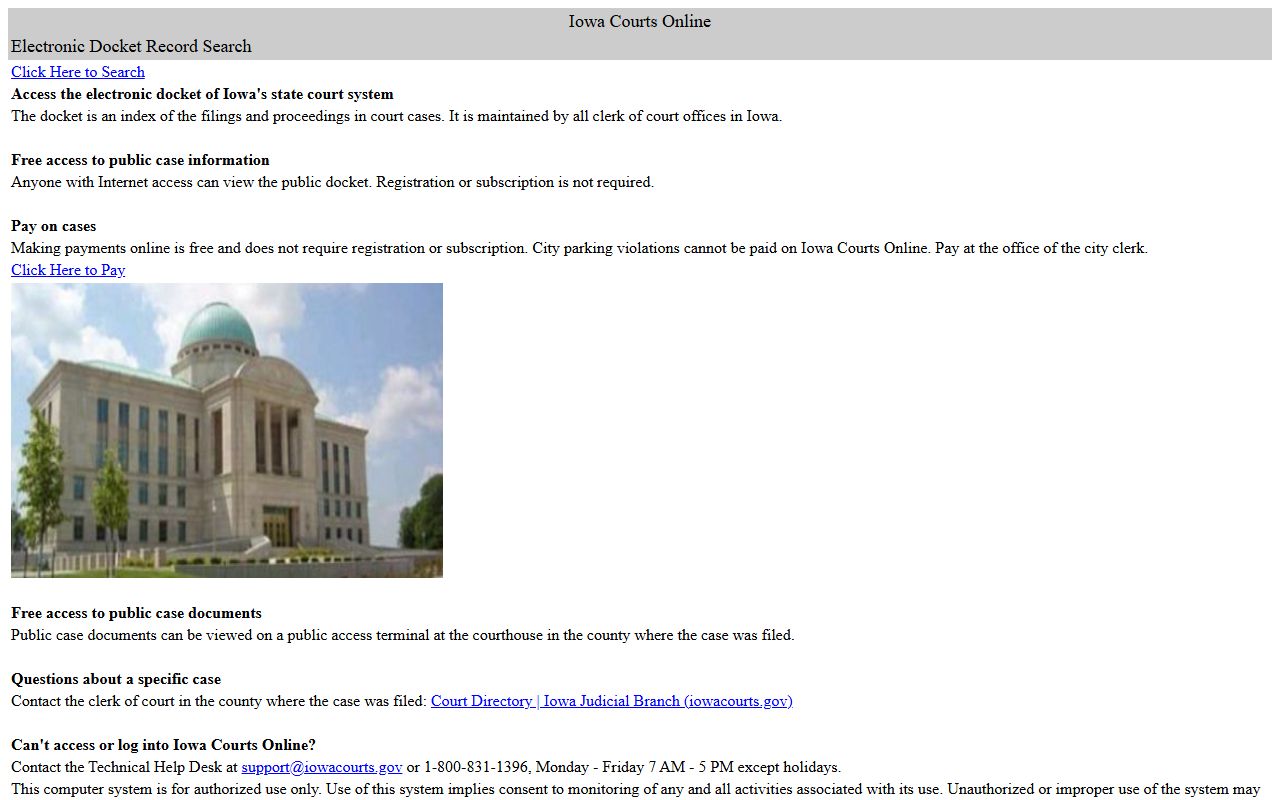
Use the docket screen for court records, not as a live jail roster. A person can be in custody before a court case appears, and a person can have an older court case after release from jail.
Court Search Fields for Montgomery County Cases
The free public search is useful when the name or case number is known. The official help guide says a last or firm name search requires at least two letters. If a first initial is used, do not add a period after the initial. Case ID is a separate search path, and the guide describes a case ID as a 17-character identifier with capitalized letters. Citation number and appellate fields are separate from an ordinary trial court name search.
| Search Field | Use | Notes |
|---|---|---|
| Last/Firm name | Name search | At least two letters are required for a name search. |
| First Name | Name search refinement | Optional; do not place a period after a first initial. |
| AND/OR | Name matching control | AND requires both entered names; OR allows either. |
| Case ID | Direct case lookup | Seventeen characters; letters must be capitalized. |
| Citation Number | Traffic or citation path | Use when the citation number is known. |
| Advanced fields | Limited public-terminal or subscriber access | May include issues, case type, current status, event, and filed-between filters. |
How Charges Get Filed After an Arrest: Complaint, Information, and Indictment
After a Montgomery County arrest, the booking process may begin with law-enforcement allegations. The court record begins when a charging document is filed and accepted into the case system. A complaint can start an early criminal case, an information is a prosecutor-filed charging document, and an indictment is returned through a grand jury process. The specific path depends on the offense, prosecutor decisions, and court procedure.
| Document | Filed By | Common Role |
|---|---|---|
| Complaint | Officer or prosecutor | Starts or supports the initial court case after an arrest. |
| Information | County Attorney | States the prosecutor's formal charges in many criminal cases. |
| Indictment | Grand jury | Formal accusation used in some serious cases. |
Do not assume the first booking label is the final charge. The County Attorney can file a different count, add a count, reduce a count, or dismiss a count based on the evidence and applicable law.
Charge Status and What It Means
Charge status describes where a count stands inside the court case. A status can change after initial appearance, after review by the Montgomery County Attorney, after plea negotiations, or after a hearing. Read each count separately because one charge may be dismissed while another remains pending or ends in a conviction.
| Status | What It Means |
|---|---|
| Pending | The charge is active and has not reached a final disposition. |
| Amended / Reduced | The filed charge changed, often by prosecutor action or court order. |
| Dismissed | The court record shows the count was ended without a conviction on that count. |
| Disposition | The current or final outcome, such as conviction, dismissal, acquittal, deferred judgment, or another court action. |
Bond and Release After an Arrest
Iowa Code 804.21 governs the early step after arrest: an arrested person must be taken before a magistrate without unnecessary delay and, if a magistrate is available, within 24 hours. Iowa Code 811.2 governs release conditions and bond decisions. In practice, a Montgomery County booking may start with temporary custody information, then a magistrate or judge addresses release conditions at or after the first appearance.
| Release or Bond Type | How It Works |
|---|---|
| Promise to appear / own recognizance | The court allows release without a posted cash or surety bond, subject to appearing as ordered. |
| Cash bond | Money is posted as ordered by the court; confirm the correct posting location before paying. |
| Surety bond | A bondsman or surety may be involved when allowed by the court order. |
| No-bond or hold status | Release may be blocked by a court order, warrant, detainer, probation/parole issue, DOC hold, federal hold, or another agency. |
Montgomery County does not publish a complete jail bond instruction page in the research reviewed. Call the Sheriff's Office at 712-623-5107 to confirm whether the person has a bond and where it can be posted. Check Iowa Courts Online after the case appears for court financial and case information, but do not treat the court payment link as a complete jail bond procedure.
Warrants That Lead to an Arrest
No official Montgomery County active-warrant search was located on the county sheriff pages. For warrant questions, call the Montgomery County Sheriff's Office at 712-623-5107 and avoid relying on third-party warrant lists. Bench warrants and warrant-related events may appear in Iowa Courts Online when they are tied to a public criminal or traffic case. Red Oak Police may be the arresting agency for incidents inside the city, but jail custody questions route back through the county sheriff.
An arrest warrant authorizes arrest based on alleged offense or probable cause. A bench warrant is usually issued by a judge after a missed appearance or court-order violation. A fugitive hold or detainer can involve another county, another state, DOC, U.S. Marshals, ICE, or another agency. A person may satisfy a local bond and still remain in custody because a second hold is unresolved.
Charges vs. Convictions
An arrest, a booking charge, and a filed court charge are not convictions. A conviction generally requires a guilty plea, verdict, or other court disposition that legally establishes guilt. Court records after an arrest should be read with that distinction in mind, especially when the case is pending, amended, dismissed, or eligible for later expungement.
| Charge | Conviction | |
|---|---|---|
| Stage | Accusation or filed count after arrest. | Outcome after plea, verdict, or qualifying court action. |
| Proof level | May begin with probable cause or prosecutor filing standards. | Requires proof beyond a reasonable doubt or an admitted plea. |
| Record meaning | Shows what was alleged or filed. | Shows a resolved finding or plea on the offense. |
Sealed vs. Expunged Arrest Records
Iowa Code chapter 901C governs several expungement paths, including certain acquittals, dismissals, and eligible misdemeanor convictions. Expungement is not automatic for every arrest, and eligibility depends on the statute, disposition, waiting period, and case history. A dismissed charge in Iowa Courts Online may still require a separate court process before public access changes.
| Sealed or Restricted | Expunged | |
|---|---|---|
| Public visibility | Public access may be limited by court order, rule, or confidentiality law. | The record is treated under the expungement statute and may be removed from ordinary public access. |
| Who may still see it | Courts, law enforcement, or authorized users may retain limited access. | Access depends on Iowa law and the order entered in the case. |
| Common trigger | Juvenile, protected, sealed, or confidential material. | Acquittal, dismissal, or eligible misdemeanor conviction under chapter 901C. |
Montgomery County Clerk of Court Contact
The Iowa Judicial Branch lists the Montgomery County Clerk of Court at 105 Coolbaugh Street, P.O. Box 469, Red Oak, IA 51566. The phone number is 712-623-4986, and the fax number is 712-623-4987. The county's local clerk page points users toward Iowa Courts Online for current financial information and Iowa Courts payment tools, but it does not publish clerk office hours in the research reviewed.
The Iowa Judicial Branch Montgomery County page is a useful confirmation source for clerk contact details.
The Iowa Judicial Branch Montgomery County court page lists the local clerk address, phone, and fax.

For older files, restricted records, or items that are not visible through the free public search, contact the clerk or use a courthouse public-access terminal when available.
Background Check Considerations
Iowa DPS/DCI criminal-history checks are different from a casual docket lookup, and a consumer background report is different again. Court records after a Montgomery County arrest can help identify a case, but they should not be treated as a complete employment, credit, insurance, tenant, or licensing report.
Important: Montgomery County Inmate Population is not a consumer reporting agency and cannot be used for FCRA-regulated decisions.
Restricted Court Records After an Arrest in Montgomery County
Iowa public access is broad, but not every record or field is public. Juvenile matters, sealed records, protected personal information, medical details, some investigative material, and confidential filings may be withheld or redacted. Iowa Code chapter 22 supplies the open-records framework, while court rules and case-specific orders can control court access. If a charge is missing from the public search, the reason may be timing, spelling, county mismatch, restriction, expungement, or the fact that no formal case has been filed yet.